
Median $100,750: U.S. Project Manager Salary and Negotiation Steps

Median U.S. project manager pay is $100,750. See percentile ranges, top industries and cities, PMP impact, and step-by-step tactics to negotiate higher pay.
The median U.S. project manager earns $100,750 a year, according to BLS data from May 2024, with most professionals landing between roughly $74,100 and $129,690. That middle-50% range, drawn from government wage data and echoed in PMI's certification research, is your starting point for any negotiation. Certification, industry, and project scale push pay well beyond that midpoint.
TL;DR:
- Median project manager salaries range from roughly $74,100 at the 25th percentile to $129,690 at the 75th percentile, with industry and location significantly affecting pay.
- Certification like PMP boosts pay, especially when combined with larger project responsibilities and a proven track record of managing bigger budgets or teams.
- Salaries in high-paying industries such as aerospace, defense, and finance, as well as in high-cost metro areas, tend to be well above the median, often reaching the 75th or 90th percentile.
- Actual market rates differ between sources: BLS offers the most reliable population-level median, while aggregators provide more current, location-specific insights.
- Full-time project roles generally offer more stable income and benefits, but experienced contractors with strong networks can earn more through gig work, depending on risk tolerance.
Table of Contents
- Why BLS, Glassdoor, and Indeed Report Different Numbers
- What Do Entry, Mid, and Senior Project Managers Earn?
- Which Industries and Cities Pay Project Managers the Most?
- How Much Does PMP Certification Actually Raise Your Pay?
- Median vs. Mean: Which Number Should You Actually Use?
- How Do You Actually Raise Your Project Manager Salary?
- Contract vs. Full-Time: Which Pays More?
- Is Project Manager Pay Actually Growing?
- How Does US Project Manager Pay Compare Globally?
- What Benefits and Bonuses Come With a PM Salary?
- Why Salary Data Only Tells Half the Story
- Turn Your Salary Number Into a Career Plan
- Sources
- FAQ
Why BLS, Glassdoor, and Indeed Report Different Numbers
You've probably seen three or four different "average project manager salary" figures floating around, and none of them quite agree. Here's why.
The Bureau of Labor Statistics puts the median at $100,750 and the mean somewhat higher, based on employer-reported payroll data covering the full national workforce. That's the most defensible number when you need a population-level anchor, not a guess pulled from a handful of self-reported listings.
Private aggregators tell a related but different story:
- Indeed reports average pay near $100,000, drawn from a mix of user-submitted salaries and job postings.
- ZipRecruiter shows an average around $102,682, updated frequently as new postings roll in.
- Glassdoor's figures shift with its own self-reported sample, which skews toward whoever chooses to submit data.
The gap comes down to sample size, update frequency, and whether the data reflects actual payroll or job-ad asking pay. If you're setting a hiring budget or building a legal case for pay equity, lean on BLS. If you're gauging how the market is moving right now in a specific city, aggregator data adds useful, timelier color. Rippling's synthesis of BLS OEWS data lands the practical mid-level hiring band around $78,000 to $133,000, which tracks closely with the government figures.
What Do Entry, Mid, and Senior Project Managers Earn?
Percentile bands tell you more than a single average ever could, because project management covers everyone from a first-year coordinator to a portfolio director overseeing nine-figure budgets. The BLS OEWS wage table breaks it down like this for May 2024:
- 10th percentile: about $57,500. This is typical entry-level or coordinator pay, often for someone with under two years of experience or a title like "junior project coordinator."
- 25th percentile: about $74,100. Early-career PMs with a couple of years managing small to mid-sized projects sit here.
- 50th percentile (median): about $98,580 to $100,750, depending on the exact BLS series referenced. This is the standard mid-career benchmark.
- 75th percentile: about $129,690. Senior PMs and those managing larger cross-functional initiatives typically land in this band.
- 90th percentile: about $163,040 to $165,790. Program managers, portfolio directors, and technical PMs in high-demand sectors cluster here.
Specialized titles, like technical program manager or IT portfolio manager, routinely push into that top band faster than generalist roles, because they combine project discipline with scarce domain expertise.
Which Industries and Cities Pay Project Managers the Most?
Industry matters almost as much as title. Pharmaceutical, aerospace and defense, and financial services consistently pay above the national median, largely because project failures in those sectors carry higher regulatory or financial risk. Professional services firms managing large client engagements also cluster near the top of the range.
Metro location shifts pay just as sharply:
- Coastal tech hubs and major finance centers often post salaries at or above the 75th percentile nationally.
- Mid-sized metros in the Midwest and South generally land near the median or slightly below.
- State-level medians can vary by tens of thousands of dollars once you account for cost-of-living differences.
A salary around $130,000 in a high-cost metro may have less real purchasing power than about $95,000 in a lower-cost city, so run any offer through a cost-of-living calculator before comparing it to national percentiles. If you're weighing a relocation or an industry switch specifically to boost pay, target roles that sit at the 75th to 90th percentile in your new market. Anything below that usually doesn't justify the disruption.
How Much Does PMP Certification Actually Raise Your Pay?
PMI reports that certified project managers earn a clear, measurable premium over non-certified peers, and that premium compounds the longer someone holds the credential, according to PMI's 2025 salary survey findings. Recently certified PMs see a smaller bump than those who've held the PMP for five or ten years, which suggests the credential works best paired with a track record, not as a standalone credential.
Other levers matter too, and some move pay faster than tenure alone:
- Managing a larger project budget or headcount often raises pay independent of years in the role.
- Technical domain expertise (cloud infrastructure, clinical trials, defense contracting) commands a premium on top of general PM skills.
- Moving into program or portfolio management, where you oversee multiple projects at once, typically opens a new, higher pay band entirely.
If you're weighing whether certification is worth the time and cost, our breakdown of PMP certification costs walks through the investment against the expected return.
Median vs. Mean: Which Number Should You Actually Use?
Median and mean tell different stories, and using the wrong one can cost you real money in a negotiation. The median is the midpoint. The mean, or average, gets pulled upward by a small number of very high earners, like program directors managing multimillion-dollar portfolios. That makes the median the more defensible, harder-to-argue-with anchor when you're asking for a raise or setting a hiring range.
Here's how to put that into practice:
- Anchor to the median for a standard market-rate ask. It reflects what a typical qualified PM earns, not a skewed average.
- Anchor to the 75th percentile when you bring scarce skills, like a niche certification, a regulated industry background, or proven success on large-scale projects.
- Always compare total compensation, not just base pay. Bonus targets, equity, and benefits can add 10% to 20% or more on top of salary, and ignoring them undervalues a competing offer.
Pro Tip: Pull the median figure from BLS, then quote your specific accomplishments (budget size, team size, project outcomes) to justify moving toward the 75th percentile instead of settling for the midpoint. Our guide on how to negotiate salary breaks this into a step-by-step script.
How Do You Actually Raise Your Project Manager Salary?
Pay increases rarely happen just because you waited long enough. They happen because you can point to evidence.
- Document every project's budget size, team headcount, and measurable outcome, like cost savings or on-time delivery rate, so you can quantify your scale of responsibility, not just your years of experience.
- Push for ownership of larger or higher-visibility projects before you ask for a raise, since project scope moves pay faster than tenure alone.
- Time your certification strategically. Earning a PMP right before a performance review or job search maximizes its leverage.
- Highlight metrics on your resume and in interviews, such as "managed a $4M cross-functional rollout" instead of "led project team."
Pro Tip: If your current employer can't match market rate even with strong evidence, an external move often closes the gap faster than an internal promotion cycle, especially in industries where PM demand outpaces supply.
Contract vs. Full-Time: Which Pays More?
That premium exists for a reason: contractors absorb their own health insurance, retirement contributions, paid time off, and the gaps between assignments that a full-time employee doesn't have to think about.
Run the math past the headline rate before assuming contracting wins. A contractor billing $70 an hour full-time hours looks like roughly $145,000 annualized, well above the BLS median. But subtract self-funded benefits, self-employment tax obligations, and unpaid downtime between contracts, and the real take-home often lands closer to, or sometimes below, a full-time salary at the 75th percentile with a strong benefits package.
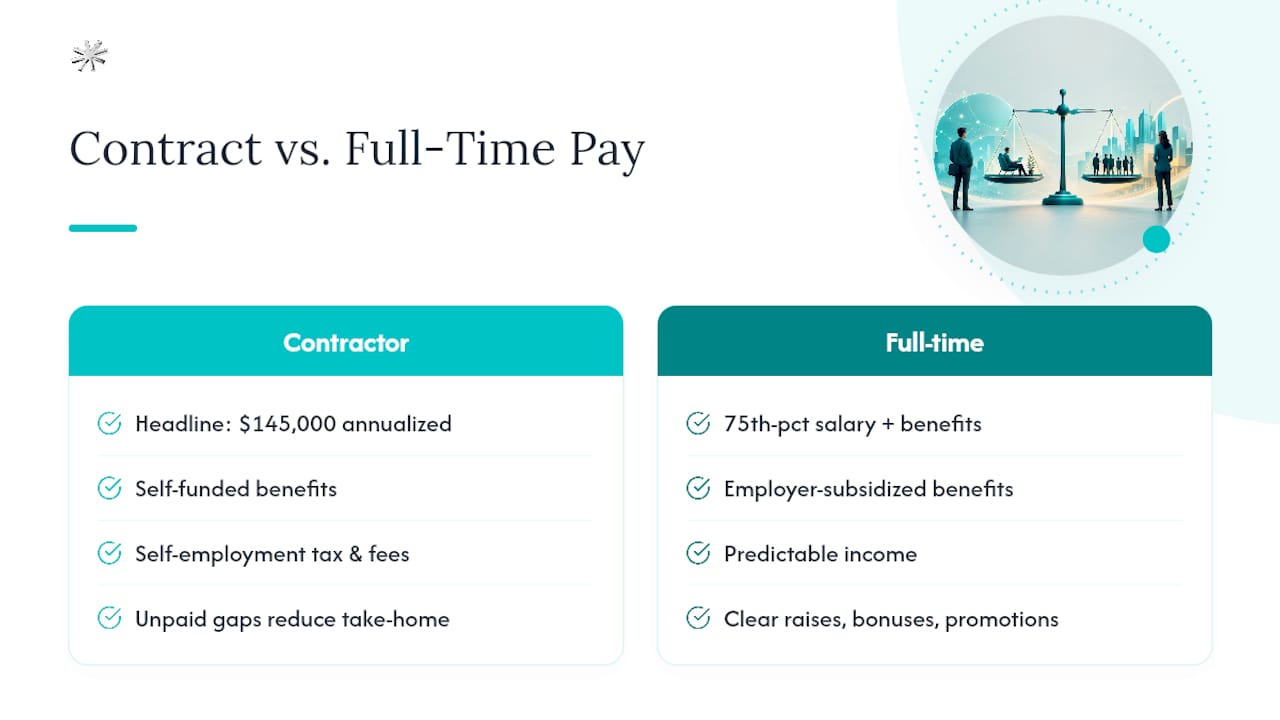
Full-time roles offer something contracting structurally can't: predictable income, employer-subsidized benefits, and a clearer path to raises, bonuses, and internal promotion into program or portfolio roles. Contract work tends to suit PMs who value flexibility, want to sample different industries quickly, or are filling gaps between full-time roles.
The right choice depends on your risk tolerance and your stage of life. Early-career PMs building a resume often benefit more from full-time stability and structured mentorship. Experienced PMs with a strong network and diversified skill set can often out-earn a full-time salary through contracting, but only once they've built enough of a pipeline to avoid long unpaid gaps.
Is Project Manager Pay Actually Growing?
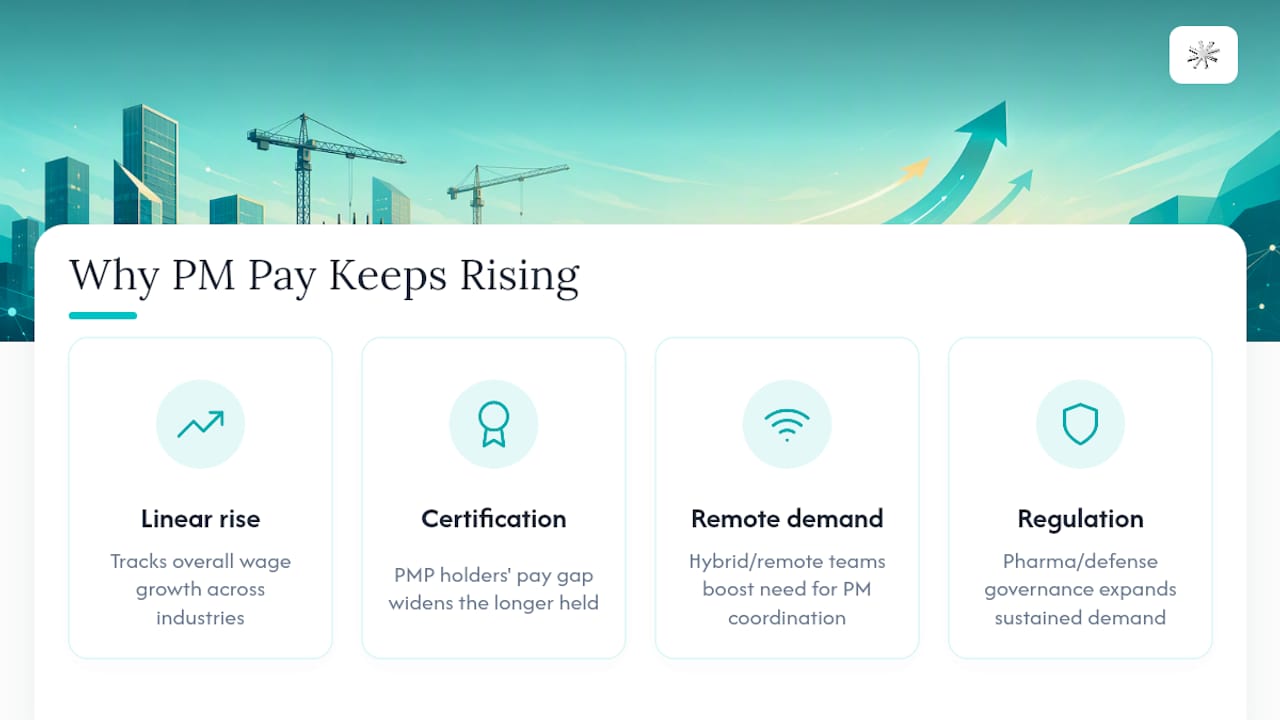
Project management pay has trended upward steadily rather than spiking, and that steadiness is itself worth noting. Unlike some tech roles that saw sharp pay swings during hiring booms and subsequent corrections, project management compensation has grown in a more linear pattern, tracking closely with overall wage growth and demand for structured delivery skills across industries.
Several forces are driving that climb. Companies increasingly treat project management as a distinct, certifiable discipline rather than a task added to someone's existing job description, which raises the baseline value employers place on the role. The spread of hybrid and remote project teams has also increased demand for PMs who can coordinate distributed teams effectively, a skill set that didn't carry the same premium a decade ago.
Certification has played a compounding role in that growth too. As covered above, PMI's own data shows that PMP holders don't just earn more at the moment they certify. Their pay advantage widens the longer they carry the credential, which suggests employers are rewarding sustained expertise, not just a one-time credentialing event.
Expect this trajectory to continue rather than reverse. Regulated industries like pharma and defense keep expanding their project governance requirements, and that regulatory pressure alone sustains demand for experienced PMs regardless of broader economic cycles. If you're early in your career, that's a strong argument for building toward certification and larger project ownership now rather than waiting for a market dip to force your hand.
How Does US Project Manager Pay Compare Globally?
U.S. project managers earn meaningfully more than their counterparts in most other developed economies, even after accounting for currency conversion. Salaries in Western Europe, for instance, typically run lower in absolute dollar terms, partly because employer-provided benefits like healthcare and pension contributions are baked into national systems rather than added on top of a base salary the way they often are in the U.S.
The comparison isn't purely apples to apples, though. Many countries pair lower base pay with stronger statutory benefits: longer paid leave, subsidized healthcare, and pension guarantees that reduce the need for a high salary to achieve the same quality of life. A U.S. project manager's higher gross pay often has to cover costs, like private health insurance premiums, that come standard elsewhere.
Emerging markets, meanwhile, show project management salaries far below U.S. levels in absolute terms, though local purchasing power can offset some of that gap. Multinational companies increasingly benchmark PM pay regionally rather than globally, which is part of why a U.S.-based PM working for a global firm can still expect a distinctly higher number than a peer with similar responsibilities based abroad. For American readers, the practical takeaway is straightforward: the U.S. market remains one of the higher-paying environments globally for this profession, and that gap is a legitimate factor if you're weighing an international relocation for a PM role.
What Benefits and Bonuses Come With a PM Salary?
Base salary is only part of the picture, and comparing job offers on salary alone is one of the most common mistakes candidates make. A thorough comparison has to include bonus structure, equity, and benefits, because those components can shift the real value of an offer by tens of thousands of dollars.
Annual performance bonuses are standard for mid-level and senior PM roles, typically ranging from 5% to 15% of base salary depending on industry and company size, though senior program and portfolio roles sometimes see higher targets tied to larger deliverables. Tech and finance companies frequently add equity grants, restricted stock units, or stock options, which can meaningfully outpace the bonus component over a multi-year vesting schedule.
Standard benefits round out the package: employer-subsidized health insurance, 401(k) matching, paid time off, and increasingly, remote or hybrid work flexibility as a negotiable perk rather than a fixed policy. Some employers, particularly in regulated industries like pharma and defense, also offer certification reimbursement, covering the cost of a PMP or similar credential as a retention tool.
When you're comparing two offers, build a simple total compensation table: base, target bonus, expected first-year equity value if applicable, and the dollar value of benefits like health insurance subsidies. A lower base salary with strong equity and full certification reimbursement can outperform a higher base with thin benefits over a two or three-year horizon.
Why Salary Data Only Tells Half the Story
Here's what most salary guides get wrong: they treat the number as the destination instead of the starting point. Knowing the median tells you what a typical PM earns. It doesn't tell you why some PMs earn 60% more than others doing what looks like the same job on paper.
The honest answer, based on everything PMI's own research shows, is that pay in this field rewards evidence of scale, not just tenure. A PM who managed a $2 million rollout for three years will often out-earn a PM with five years of experience on smaller, lower-stakes projects. That's uncomfortable for anyone counting on time-in-role to carry them forward, but it's also good news: it means you can compress your timeline to a raise by deliberately seeking larger scope, not by waiting.
The other underappreciated piece is that certification isn't a one-time unlock. PMI's data on compounding tenure premiums suggests employers keep paying more for PMP holders years after certification, likely because sustained credentialing signals ongoing discipline rather than a box checked early in a career. If you're deciding when to certify, the data argues for doing it sooner rather than later, so the compounding effect has more years to work in your favor.
— Shane
Turn Your Salary Number Into a Career Plan
Knowing your market rate is only useful if you know what to do with it. NueCareer's 7-Minute Career Quiz takes the benchmarks in this guide and turns them into something personal: a strengths-based match to roles and career paths that fit who you are, including project management tracks you might not have considered and adjacent paths that pay even more.

Once you have your match, the platform builds a personalized transition roadmap and gives you the tools to act on it, including a resume rewrite, cover letter drafts, and the salary negotiation email generator to turn your target percentile into an actual ask. Whether you're aiming for your first PM title or pushing from mid-level toward program management, NueCareer gives you a plan built around your specific strengths instead of a generic checklist. Take the quiz and see where you actually fit.
Sources
- U.S. Bureau of Labor Statistics — Project management specialists (Occupational Outlook Handbook)
- PMI press release — PMP certification holders build career momentum and earning advantage (2025)
- Rippling — Project manager salary in the US (2026)
- Indeed — Project manager salary in United States
FAQ
What Does a Project Manager Actually Spend Most of Their Time On?
Most of a PM's job involves coordination, not technical execution: tracking budgets, managing stakeholder communication, resolving scope conflicts, and keeping timelines realistic. Employers pay a premium for PMs who can quantify those outcomes, like budget adherence or on-time delivery rate, rather than just describe their duties.
Can Project Managers Make Over $200,000?
Yes, though it's uncommon at the standard PM title level. Senior program managers, portfolio directors, and technical PMs in high-paying industries like pharma, defense, or big tech can clear $200,000 in total compensation once bonus and equity are included, particularly in high-cost metros where the 90th percentile already sits near $165,790 in base salary alone.
What Jobs Pay $500,000 a Year in the US?
Roles paying very high six-figure salaries are typically executive-level positions, such as VP or C-suite roles, senior physicians in high-demand specialties, or top-tier finance professionals like investment bankers and hedge fund managers. Standard project management roles, even at the senior program or portfolio director level, generally don't reach that figure through base salary and bonus alone.
Is Project Management a High-Paying Career?
Project management pays well above the U.S. median wage across occupations, with a median of $100,750 annually and a clear path toward $130,000 or more with experience, certification, and larger project scope. It's not the highest-paying field in absolute terms, but it offers a reliable, in-demand career with strong upward mobility for those who build a track record on bigger initiatives.
Does PMP Certification Really Increase Salary?
Yes. PMI's research shows certified project managers report meaningfully higher median salaries than non-certified peers, and that premium grows the longer someone holds the credential. It works best combined with demonstrated project scale, not as a standalone credential.